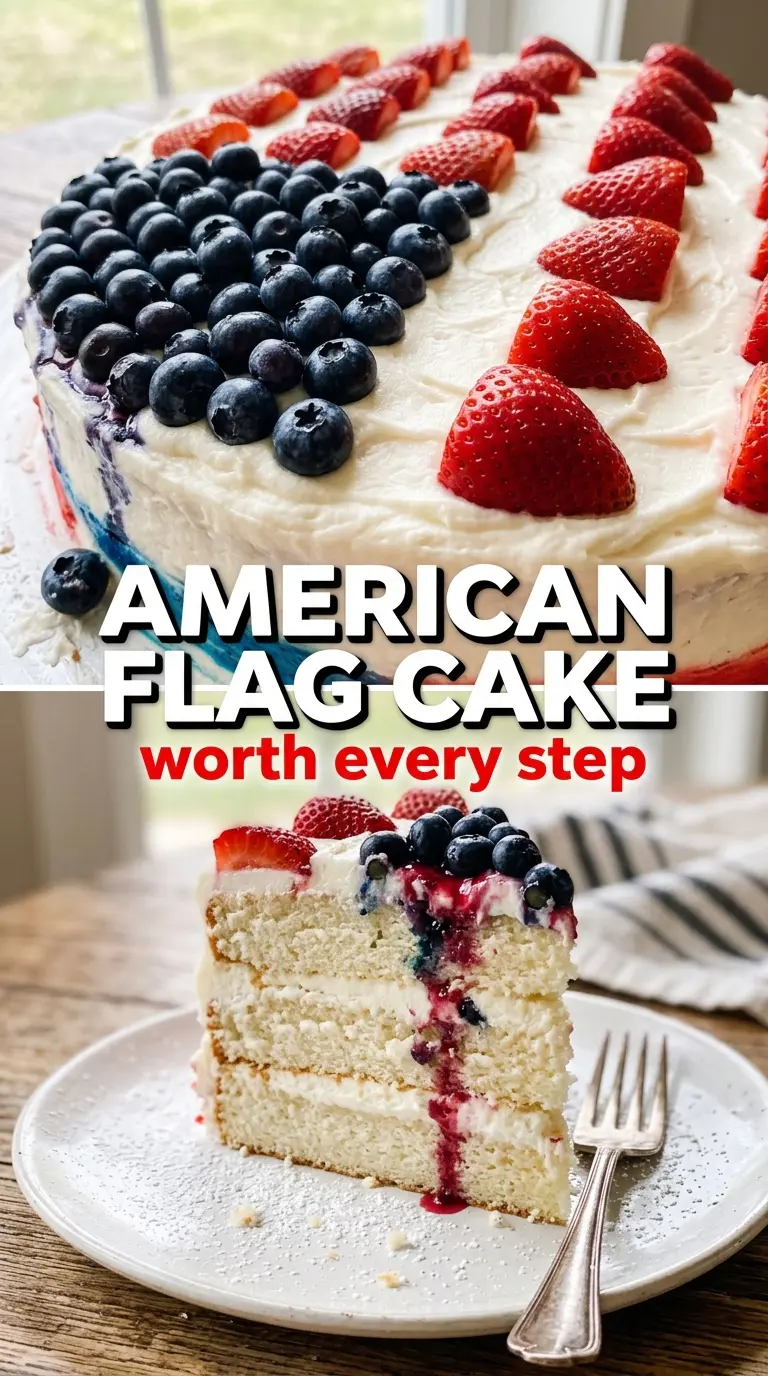
American Flag Cake earns its spot at the center of the table because it looks festive without needing fussy decorating skills, and it slices into neat squares that feed a crowd with no drama. The cake stays soft under a thick blanket of vanilla buttercream, while the berries on top add fresh flavor and keep each bite from tasting overly sweet.
The trick is starting with a completely cool cake and a frosting that spreads like satin, not stiff paste. A warm cake will melt the buttercream and make the flag design slide around, and frosting that’s too thick will fight you when you’re trying to make straight rows. Fresh strawberries cut lengthwise lay flatter than chunky slices, and a tight blueberry rectangle gives the canton the sharpest edge.
Below you’ll find the decorating order that keeps the stripes clean, plus a few smart swaps if you want to use frosting instead of fruit for the white stripes or need to make the dessert ahead.
The frosting spread smoothly and the berries stayed put after chilling. I used banana slices for the white stripes and the cake sliced cleanly without the design smearing.
Like this American Flag Cake? Save it to Pinterest for the next time you need a clean, crowd-size dessert with vivid berry stripes and an easy patriotic finish.
The One Thing That Keeps the Flag from Sliding
The biggest mistake with a decorated sheet cake is rushing the frosting. If the cake is even a little warm, the buttercream softens too fast and the berries start drifting, which turns crisp stripes into a blurry patchwork. Let the cake cool all the way to room temperature, then chill the frosted surface for a few minutes before you start placing fruit.
That short chill gives you a firm base for the canton and keeps the stripes where you put them. It also makes slicing cleaner later, especially if you’re using banana for the white stripes. A soft frosting base is easier to work with than a heavily whipped one, because the fruit can settle into it instead of rolling around on top.
What Each Part of the Decoration Is Doing
- White cake mix — The boxed mix gives you a sturdy, neutral base that can carry a lot of frosting and fruit without collapsing. If you want a homemade cake, use a white or vanilla sheet cake with a tight crumb so the surface stays level.
- Butter — Real butter gives the frosting enough body to hold clean lines and enough richness to balance all the fruit. Margarine won’t whip the same way, and the frosting usually ends up looser and less stable.
- Powdered sugar — This is what turns the butter into a pipeable buttercream that can support the strawberries and blueberries. Add it gradually or you’ll get a gritty cloud of sugar and a lumpy finish.
- Heavy cream — A little cream loosens the frosting just enough to spread smoothly across the cake. Add it one tablespoon at a time so you stop at spreadable, not soupy.
- Strawberries — Slice them lengthwise so they lay in neat rows and don’t wobble. Smaller berries are easiest to line up because they create straighter stripes with fewer gaps.
- Blueberries — These form the canton, so use the best-looking berries you have. A dense, even rectangle reads like a flag; scattered berries look unfinished.
- Banana slices or extra frosting — Banana works if you want a fresh white stripe, but it browns as it sits. If you need the cake to hold for several hours, pipe frosting instead for a cleaner look.
Building the Flag in the Right Order
Whipping the Buttercream First
Beat the softened butter until it turns pale and fluffy before anything else goes in. That gives the frosting a lighter texture and keeps the sugar from clumping into heavy pockets. Add the powdered sugar gradually, then the vanilla, then just enough cream to make the frosting spreadable with an offset spatula. If it looks grainy, it usually needs another minute of beating and a splash more cream.
Frosting the Sheet Cake
Spread the buttercream over the cooled cake in one even layer, going a little thicker than you think you need. A thin coat leaves the cake surface peeking through and makes the fruit harder to anchor. Work gently so the crumb stays put, and smooth the top as much as you can before the berries go on. Once the fruit is added, every ridge becomes part of the design.
Laying Out the Canton and Stripes
Start with the blueberry rectangle in the upper left corner so you can judge the rest of the design around it. Then build the strawberry rows across the cake, keeping the slices flat and slightly overlapping so the red bands read as full lines. If the strawberries are watery, blot them dry first or their juices will tint the frosting pink. Finish by filling the white gaps with banana slices or neat lines of white frosting right before serving.
Chilling Before the First Slice
Refrigerate the finished cake long enough for the frosting to firm up and the fruit to settle into place. That short chill is what keeps the flag design intact when you cut it. Use a sharp knife wiped clean between slices for the neatest squares. If the blade drags through the berries, the cake probably needed a few more minutes in the fridge.
Three Ways to Make the Design Fit Your Crowd
Use Frosting for Every White Stripe
If you want a cleaner, longer-lasting finish, pipe white frosting between the strawberry rows instead of using banana. You lose the fresh fruit note, but the design holds up better on a warm day and won’t brown while it sits out.
Make It Gluten-Free with a Trusted Cake Mix
Swap in two boxes of a gluten-free white cake mix and bake according to the package directions. The decoration method stays the same, but gluten-free cakes can be a little more delicate, so cool the layers completely before frosting and use a gentle hand when spreading the buttercream.
Turn It Into a Smaller Crowd Cake
Bake the mixes in two 9×13 pans and use one pan for a smaller flag or split the decoration across both. This gives you the same look with a thinner cake, which is handy when you don’t need 20 servings and want shorter bake times.
Storage and Reheating
- Refrigerator: Store covered for up to 3 days. The berries stay best on day one, and the bananas will brown if they sit too long.
- Freezer: I don’t recommend freezing the decorated cake. The fruit turns soft and watery after thawing, which ruins the flag pattern.
- Reheating: This cake is served chilled or at cool room temperature, not reheated. Let slices sit out for 15 to 20 minutes before serving so the buttercream softens a little and the crumb tastes lighter.
Questions I Get Asked About This Recipe

American Flag Cake
Ingredients
Equipment
Method
- Heat and bake both white cake mixes in a large 12x18 sheet pan (or two 9x13 pans joined together) according to package directions, until a toothpick comes out clean and the tops spring back at 325°F to 350°F. Let the cakes cool completely in the pans, then remove for frosting.
- Beat the softened unsalted butter until fluffy, about 2–4 minutes. Gradually add powdered sugar, then mix in vanilla and 1 tbsp heavy cream at a time until the frosting is smooth and spreadable, about 1–3 minutes, adding up to 4–6 tbsp total.
- Spread a thick, even layer of buttercream across the entire cooled sheet cake top so it’s fully covered with an opaque white surface. Use an offset spatula to keep the finish level.
- In the upper left corner, arrange the fresh blueberries into a dense rectangle to form the blueberry canton. Press them lightly so the shapes look tightly packed.
- Create the red stripes by arranging sliced strawberries flat across the length of the cake in long, uniform rows. Keep the spacing consistent so the stripes read clearly from overhead.
- Fill the white stripes by piping extra white frosting in rows between the strawberry rows, OR lay thin banana slices in the gaps for white stripes. Add enough to create visible, raised white lines between the red rows.
- Refrigerate the decorated flag cake until the frosting is set, 30–60 minutes, then slice into squares to serve. Keep leftovers refrigerated in an airtight container.